

Audiolab 7000A integrated amplifier
70 W/8 Ω, 110 W/4 Ω · min load 4 Ω · class AB · phono MM, HDMI ARC, BT, USB DAC, DAC, pre-out, sub-out, HT bypass, headphones · current: good; drive: strong; dynamic (spec.); speakers ≥ 88.1 dB/W; drives hard loads · room 12–25 m² · mid
Instalment: Buy now, pay later: 0-0-10 at our expense
prices and stock as of 2026-11-05
Audiomania expert verdict
A class-AB integrated, 2 × 70 W (8 Ω) / 2 × 110 W (4 Ω) with a 9 A current reserve and a full digital hub: an ES9038Q2M USB DAC (32/768, DSD512, MQA, Roon Tested), HDMI ARC, an MM phono stage, aptX Bluetooth. In Audiomania specialists' experience “dynamic and detailed” — the pick for rock and electronic music on ELAC, B&W, KEF in closed 14–20 m² rooms; no tone controls. AI draft, under review
Ask about Audiolab 7000A
Will it suit your amplifier or room, what else to buy, what to compare with.
Awards and recognition
- Stereonet — Stereonet Applause Award
Per the review digest on the product page (James Michael Hughes)
- Low Beats — 5 звёзд за звучание, 4,7 общая (04.2023)2023
Per the review digest on the product page (Frank Borowski)
Awards are shown only with a link to the source.
In brief
Best if you are looking for:
- an all-in-one instead of a stack: a 32/768 + DSD512 USB DAC with MQA, HDMI ARC from the TV, an MM phono stage, aptX Bluetooth AI draft, under review
- rock, electronic, hip-hop and metal on ELAC, B&W, KEF, DALI — specialists call it “dynamic and detailed” with “excellent speaker control” AI draft, under review
- closed rooms of 14–20 m² with 86–88 dB bookshelf speakers, including at low volume AI draft, under review
- a step up from the 6000A: “more dynamic, a wider stage and better detail” AI draft, under review
- home cinema and external amplifiers: a power-amp direct input and pre-out, 12 V trigger AI draft, under review
Keep in mind:
- no tone controls — it runs in Direct; with dark speakers (Mission ZX2) an owner found “no treble at all”, so pick a neutral or bright partner AI draft, under review
- no dedicated sub output — connect via Pre-Out or at high level from the speaker terminals AI draft, under review
- no network: Roon and streaming only via USB from a computer/streamer or Bluetooth AI draft, under review
- for an 18 m² alcove opening into 80 m² a specialist found it “a bit weak” and preferred the NAD C3050 AI draft, under review
Product DNA
L178%A structured sound passport: every value carries a source and a confidence.
- Current capability
- good (4/8 Ω = 1.57)calculated0.75
- Drive class
- strongcalculated0.75
- Sound character
- dynamicAudiomania specialist0.75
± 1
Alternative value
- analytical customers0.25
«даже немного прозрачней» лампового класса A, «но чего-то не хватает» — намёк на аналитичность
- analytical customers0.25
- Speaker fit
- speakers from 88.1 dB/W, at least 4 Ω; rooms up to 40 m² at 88 dB/Wcalculated0.75
- Drives difficult loads
- yescalculated0.75
- Use scenarios
- no confirmed data
- Optimal room area
- 12–25 m² (10–35)Audiomania specialist0.5
- Tier
- midcalculated1
- What else you need
- speaker cable, USB cablecalculated1
Sound profile
The profile appears after an Audiomania expert audition.
What the experts say
«Автор статьи James Michael Hughes сравнил его с флагманской моделью 9000A и тоже наградил званием «Stereonet Applause Award» - «Аплодисменты от журнала Stereonet»!»
Stereonet, James Michael Hughes Read the review
«выставил усилителю отличные оценки: звучание - «5 звездочек», удобство работы – «4.5 звездочки», качество изготовления - «4.5 звездочки», и общая оценка – «4.7 звездочки»!»
Low Beats, Frank Borowski, 2023 Read the review
Sound character
The delivery is energetic: specialists speak of “dynamics and energy” for rock, “clear, articulate sound” for hip-hop and “excellent speaker control”; an owner comparing it with a class-A tube amp found it “almost the same, even slightly more transparent”. AI draft, under review[4]
Against the 6000A — “more dynamic, wider stage, better detail”; against the Rotel A14 MkII — “slightly less universal on difficult genres”. No tone controls and a direct path, so the speakers' own character comes through uncorrected. AI draft, under review[3]
Use scenarios
Suits:
- rock, electronic, metal and hip-hop on ELAC Uni-Fi, B&W 606/607, KEF Q AI draft, under review
- closed rooms of 14–20 m² with bookshelf speakers, quiet listening included AI draft, under review
- a computer/streamer over USB (32/768, DSD512, Roon), TV over HDMI ARC, vinyl on the MM input AI draft, under review
Less suited to:
- dark, soft speakers — no tone controls to add treble AI draft, under review
- open-plan 18 + 80 m² — a specialist preferred the NAD C3050 AI draft, under review
- network streaming without an external source — no network AI draft, under review
Technologies and construction
250 W toroid and 60,000 µF
What it is: A 250 W toroidal transformer, 60,000 µF of filter capacitance; output current up to 9 A.
Practical benefit: A good current reserve (110/70 = 1.57) — demanding speakers and peaks without dynamic limiting.
Discrete CFB output stages (Jan Ertner)
What it is: Discrete output stages with complementary feedback; designed by Audiolab's lead engineer Jan Ertner.
Practical benefit: Specialists: “dynamic and detailed”, “excellent speaker control”.
ES9038Q2M DAC: 32/768, DSD512, MQA
What it is: A digital section on the ES9038Q2M: up to 32-bit/768 kHz and DSD512 over USB, MQA decoding, Roon Tested; optical and two coax inputs.
Practical benefit: A computer with a Hi-Res library over USB without an external DAC — a real buyer motive (2024).
HDMI ARC
What it is: An HDMI input with the audio return channel for the TV.
Practical benefit: Films through stereo speakers without an AV receiver; a centre channel cannot be connected — it is a stereo amplifier.
2.8" IPS display with meters
What it is: A 2.8" colour IPS display (480×640): status information or level meters, needle or bar.
Practical benefit: Retro needles on demand; one owner reported a meter glitch below −35 dB after firmware 1.59.
MM phono stage
What it is: A built-in phono stage for MM cartridges with a ground terminal.
Practical benefit: A turntable (Technics SL-1500C — a real pairing) directly, without an external stage.
Pre-out and power-amp direct input
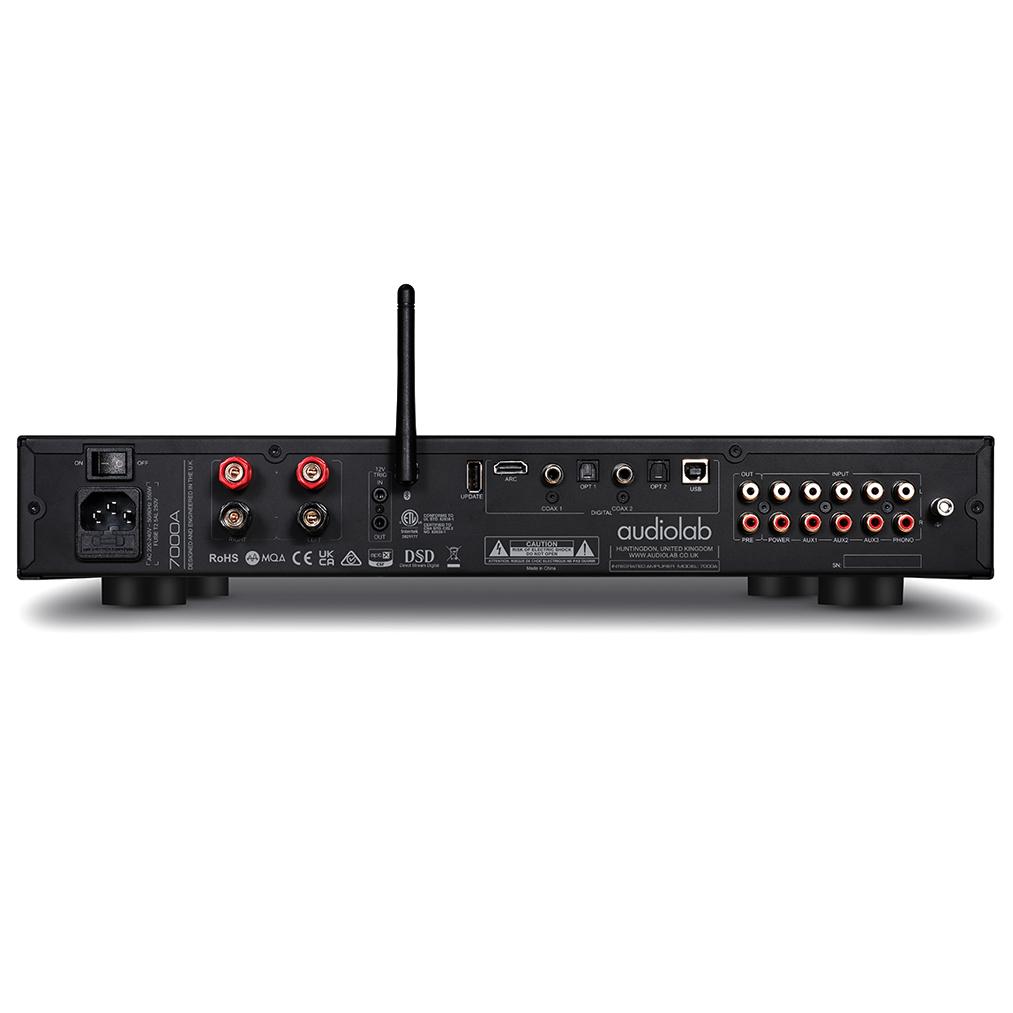
What it is: A preamp output and a power-amp direct input; 12 V trigger in and out.
Practical benefit: Home-cinema fronts from an AV processor, or a subwoofer via Pre-Out.
aptX Bluetooth
What it is: Bluetooth reception with the aptX codec.
Practical benefit: A phone without cables; no transmission to headphones.
Which speakers it drives
- Speaker fit
- speakers from 88.1 dB/W, at least 4 Ω; rooms up to 40 m² at 88 dB/Wcalculated0.75
- Current capability
- good (4/8 Ω = 1.57)calculated0.75
- Drives difficult loads
- yescalculated0.75
- Minimum load
- 4 Ωcalculated0.5
- Proven speaker pairings
- neutral, slightly bright — Specialists confirmed pairings with ELAC Uni-Fi UBR62 / Carina / Solano, B&W 606 S3 / 607 S2, KEF Q1 Meta / Q750, DALI Oberon 3, Mission M74 and Davis Krypton 3; with the dark Mission ZX2 an owner complained of missing treble — the bright Technics SB-C600E was suggestedAudiomania specialist0.75
- Output power
- 70 W / 8 Ω, 110 W / 4 Ωspec sheet1
Suitable speakers in stock
- KEF Q750 floorstanding speakersadequate
99,000 RUB · in stock
Why
KEF Q750: 8 Ω nominal — Audiolab 7000A is rated for loads from 4 Ω, compatible. Audiolab 7000A delivers ≈77 W into 8 Ω; the practice band for KEF Q750 in 19 m² at an average level is 44–73 W. Adequate.
124,990 RUB · in stock
Why
Radiotehnika Sigma 1.02: 6 Ω nominal — Audiolab 7000A is rated for loads from 4 Ω, compatible. Audiolab 7000A delivers ≈93 W into 6 Ω; the practice band for Radiotehnika Sigma 1.02 in 19 m² at an average level is 39–65 W. Adequate.
89,313 RUB · in stock
Why
Wharfedale Linton 85th Anniversary: 4 Ω nominal — Audiolab 7000A is rated for loads from 4 Ω, compatible. Audiolab 7000A delivers ≈93 W into 6 Ω against a 31–51 W practice band for Wharfedale Linton 85th Anniversary in 19 m² — the headroom that gives bass control and low-volume detail.
61,990 RUB · in stock
Why
Radiotehnika Sigma 1.01: 8 Ω nominal — Audiolab 7000A is rated for loads from 4 Ω, compatible. Audiolab 7000A delivers ≈77 W into 8 Ω; the practice band for Radiotehnika Sigma 1.01 in 19 m² at an average level is 37–61 W. Adequate.
Which sources connect
- Inputs
- Phono MM, RCA line ×3, optical, coaxial ×2, USB-B (DAC), HDMI ARC, main in (HT bypass), Bluetooth receive
- Outputs
- Pre Out, 6.3 mm headphone, speaker outputs, 12 V trigger
49,880 RUB · in stock
Why
Audiolab D7 → Audiolab 7000A: via analogue RCA (or digitally: optical/coaxial).
39,525 RUB · in stock
Why
iFi audio ZEN Stream → Audiolab 7000A: via the coaxial digital input.
12,282 RUB · in stock
Why
Premiera SX1 Pro → Audiolab 7000A: via analogue RCA (or digitally: optical).
Recommended right now
over the 45-product sampleIn-stock, current models only; refreshed with prices (2026-11-05). Not indexed.
- KEF Q750 floorstanding speakersadequate
99,000 RUB · in stock
Why
KEF Q750: 8 Ω nominal — Audiolab 7000A is rated for loads from 4 Ω, compatible. Audiolab 7000A delivers ≈77 W into 8 Ω; the practice band for KEF Q750 in 19 m² at an average level is 44–73 W. Adequate.
124,990 RUB · in stock
Why
Radiotehnika Sigma 1.02: 6 Ω nominal — Audiolab 7000A is rated for loads from 4 Ω, compatible. Audiolab 7000A delivers ≈93 W into 6 Ω; the practice band for Radiotehnika Sigma 1.02 in 19 m² at an average level is 39–65 W. Adequate.
89,313 RUB · in stock
Why
Wharfedale Linton 85th Anniversary: 4 Ω nominal — Audiolab 7000A is rated for loads from 4 Ω, compatible. Audiolab 7000A delivers ≈93 W into 6 Ω against a 31–51 W practice band for Wharfedale Linton 85th Anniversary in 19 m² — the headroom that gives bass control and low-volume detail.
61,990 RUB · in stock
Why
Radiotehnika Sigma 1.01: 8 Ω nominal — Audiolab 7000A is rated for loads from 4 Ω, compatible. Audiolab 7000A delivers ≈77 W into 8 Ω; the practice band for Radiotehnika Sigma 1.01 in 19 m² at an average level is 37–61 W. Adequate.
rules version 1.0.0+c1.0.0
Audiomania ready systems
Assembled by the rules from in-stock products around this model; prices as of 2026-11-05.
Optimal
- Speakers: Wharfedale Linton 85th Anniversary bookshelf speakers89,313 RUB
- Amplifier: Audiolab 7000A integrated amplifier (this model)104,880 RUB
- Speaker cable: Radiotehnika Volna SP2.5 Banana finished speaker cable9,690 RUB
- Stands: Radiotehnika T6 speaker stands19,990 RUB
Total: 223,873 RUB
Checks (10)
- R-ROOM-FITideal
- R-PLACEMENTno data
- R-SUB-NEEDnot needed
- R-AMP-IMPEDANCEfits
- R-AMP-POWERideal
- R-SOURCE-CHAINfits
- R-AMP-CHARACTERcomplementary
- R-TIER-FITbalanced
- R-CABLEfits
- R-STANDgood
Optimal
- Speakers: DALI Opticon 2 MK2 bookshelf speakers118,990 RUB
- Amplifier: Audiolab 7000A integrated amplifier (this model)104,880 RUB
- Subwoofer: Radiotehnika Alfa 1.05 active subwoofer27,990 RUB
- Speaker cable: Radiotehnika Volna SP2.5 Banana finished speaker cable9,690 RUB
- Stands: Radiotehnika T6 speaker stands19,990 RUB
Total: 281,540 RUB
Checks (10)
- R-ROOM-FITideal
- R-PLACEMENTno data
- R-SUB-NEEDrecommended
- R-AMP-IMPEDANCEfits
- R-AMP-POWERadequate
- R-SOURCE-CHAINfits
- R-AMP-CHARACTERcomplementary
- R-TIER-FITbalanced
- R-CABLEfits
- R-STANDgood
Comparison with similar models
How it differs from Rotel A11 Tribute integrated amplifier
Audiolab 7000A integrated amplifier:
- Power into 8 Ω: 70 W vs 50 W
Rotel A11 Tribute integrated amplifier:
—
The sound difference is not confirmed by sources — specs only.
Audiolab 7000A and Rotel A11 Tribute are the same tier; they differ in character and in the figures below.
Full comparison →How it differs from Audiolab 6000A integrated amplifier
Audiolab 7000A integrated amplifier:
- Power into 8 Ω: 70 W vs 50 W
Audiolab 6000A integrated amplifier:
—
Audiolab 7000A and Audiolab 6000A are the same lineup: the only differences are the specs below.
Full comparison →
Specifications
Main
- Output power
- 70 W / 8 Ω, 110 W / 4 Ω
- Power rating conditions
- THD, %: 1
- Topology
- class ABmanufacturer
- Peak current
- 9 Amanufacturer
- Minimum load
- 4 Ωcalculated
- A/B switch
- nocalculated
- DAC
- MQA; chip: ES9038Q2M; PCM up to: 32/768; DSD up to: DSD512
- Main in (HT bypass)
- yes
- Tone controls
- no: presentAudiomania specialist
- Direct mode
- yesAudiomania specialist
- Display
- 2,8" IPS 480×640; индикаторы уровня (стрелочный или линейный)
Construction
- Finishes
- Black, SilverAudiomania
Connection
- Speaker output pairs
- 1
- Inputs
- Phono MM, RCA line ×3, optical, coaxial ×2, USB-B (DAC), HDMI ARC, main in (HT bypass), Bluetooth receive
- Outputs
- Pre Out, 6.3 mm headphone, speaker outputs, 12 V trigger
- Phono input
- MM; no: MC
- HDMI ARC
- ARC
- USB audio input
- USB-B
- Bluetooth
- receive; codecs: aptX, SBC; no: transmit
- Pre Out
- yes
- Sub Out
- via pre-outAudiomania specialist
- Rec Out
- no
- Headphone output
- jack: 6.3 mm; impedance, Ω: 4.7
- 12 V trigger
- in-ear, out of stock
Dimensions
- Dimensions (W×H×D)
- 444 × 78 × 340 mm
Weight
- Weight
- 8.4 kg
Box contents
- Warranty
- 12 months
Documents
No documents yet.
FAQ
›Are there tone controls, or does it run in Direct only?
›Can I connect a subwoofer?
›Is the 7000A better than the 6000A only in power?
›Which speakers for the 7000A in a 14 m² room (any genre but metal and classical, under 70k)?
›Is there enough power for 86–87 dB speakers in 20 m²?
›Will it drive floorstanders in an 18 m² alcove opening into an 80 m² room?
›Is there a network connection and streaming?
›Do I have to ground the amplifier with a separate wire?
›Audiolab 7000A or Rotel A14 MkII for Arslab Classic 1.5 (classical, rock, disco, jazz vocals)?
›Why does the meter show only the left channel below −35 dB?
›Can I connect a centre channel?
Customer reviews
5.0 of 5 · 7 ratingsКонстантин Д., Коломна · 2025-08-28Excellentverified purchase
Сравниваю с ламповым усилителем класса А. Звук у Audiolab 7000A почти такой же как и на ламповом, даже немного прозрачней, но всё-таки чего-то не хватает. Впечатление только положительное! Только купил. В дальнейшем буду тестировать. Нисколько не пожалел затраченных денег, так как звуком полностью доволен.
Михаил Х., Ижевск · 2025-07-02Excellentverified purchase
Классный усилитель, цена-качество, рекомендую
Audiomania expert opinion
The 7000A is for people who want one box for every source: specialists routinely pair it with ELAC, B&W and KEF for rock, electronic and hip-hop and describe it as “dynamic and detailed” with “excellent speaker control”. Against the junior 6000A it “sounds more dynamic, with a wider stage and better detail”. AI draft, under review[4]
Two caveats from real discussions: there are no tone controls, so dark speakers can sound “as if under a blanket”; and for large open spaces a specialist preferred the more powerful NAD C3050. For versatility on difficult genres the Rotel A14 MkII was called “slightly more universal”. AI draft, under review[3]