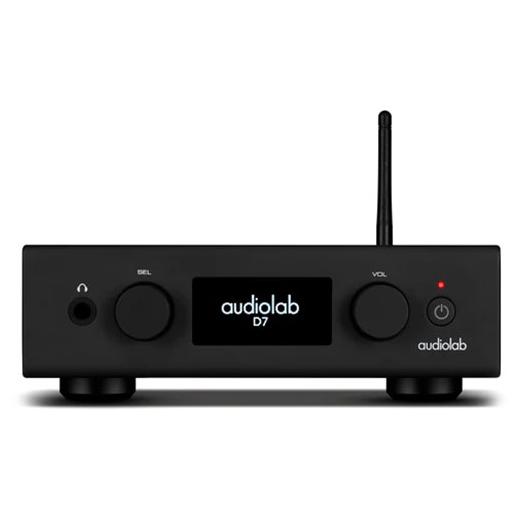


Audiolab D7 external DAC / headphone amplifier
DAC+preamp+headphone amp · in: coaxial, optical, USB-B (DAC), USB host, Bluetooth receive · out: RCA line, XLR line, 6.3 mm headphone, 12 V trigger, optical, coaxial · PCM 32/768, DSD512, MQA, headphone amp · musical (spec.) · entry
Instalment: Buy now, pay later: 0-0-10 at our expense
Delivery by: 2026-11-09
prices and stock as of 2026-11-05
Audiomania expert verdict
A desktop DAC-preamp on the ES9038Q2M with the richest connectivity at its price: 2+2 S/PDIF, PC USB up to 768/DSD512, USB drives, Bluetooth aptX HD, RCA and XLR, a 20–600 Ω headphone amp, a remote and triggers. Specialists promise “a noticeable gain” over the built-in DACs of streamers (WiiM Ultra, CXN) and amplifiers (LEAK 230); buyers note the scale of the sound. AI draft, under review
Ask about Audiolab D7
Will it suit your amplifier or room, what else to buy, what to compare with.
In brief
Best if you are looking for:
- a “digital hub” for a PC, transport, TV and phone: 2 coax, 2 optical, PC USB, USB drives, Bluetooth 5.1 aptX HD AI draft, under review
- headphones from 20 to 600 Ω — a built-in current-feedback amplifier (2.35 Ω output impedance) AI draft, under review
- an upgrade over built-in DACs in streamers and amplifiers: vs the WiiM Ultra — “a noticeable gain in detail, stage depth and musicality”; vs the LEAK 230/Cambridge CXN — “there will definitely be a gain in quality” AI draft, under review
- uncompromised Hi-Res over USB: PCM 768 kHz, DSD512, a full MQA decoder on USB, coax and optical AI draft, under review
- a balanced system: a 4.1 V XLR output, two 12 V triggers, a remote, an OLED display AI draft, under review
Keep in mind:
- stereo only: multichannel 5.1 DSD over USB “is either not recognised or returns an error” AI draft, under review
- PC USB under Windows needs drivers from the Audiolab site (link in documents) AI draft, under review
- USB drives: capacity is not limited by the manufacturer (FAT16/FAT32/exFAT), but such devices usually cap out at 2,000–5,000 files/folders; USB HDD playback only up to 96 kHz AI draft, under review
- no Wi-Fi or streaming services — it is a DAC, not a streamer; the only wireless input is Bluetooth AI draft, under review
Product DNA
L079%A structured sound passport: every value carries a source and a confidence.
- Role in the system
- DAC, preamp, headphone ampcalculated0.5
- Services
- spec sheet1
- Protocols
- bluetooth rx; AirPlay: 0; no: Chromecast, DLNA/UPnP, Roon Ready, Roon Endpoint, HQPlayer NAAspec sheet1
- Use scenarios
- ideal: Near-field desktop; good: Home stereo, TV sound; acceptable: Background listening; less suitable: Multiroom wireless, Vinyl systemcalculated0.5
- Optimal room area
- not enough data to calculate
- Tier
- entrycalculated1
- What else you need
- amplifier, interconnectcalculated1
Sound profile
The profile appears after an Audiomania expert audition.
Sound character
No audition or professional review yet — below are only facts from the specs and calculations.
Technical reference
- DAC chip
- ES9038Q2M (32 бит)spec sheet1
- Formats
- PCM up to: 32/768; DSD up to: DSD512; MQA: full; files: MP3, WMA, APE, AAC, WAV, FLACspec sheet1
- Role in the system
- DAC, preamp, headphone ampcalculated0.5
Use scenarios
Suits:
- a desktop system: PC over USB, 20–600 Ω headphones, active monitors over XLR AI draft, under review
- a DAC upgrade in a system with a WiiM/CXN streamer or a LEAK amplifier AI draft, under review
- a TV and CD transport over optical/coax, a phone over Bluetooth aptX HD AI draft, under review
- music from a USB drive without a computer (FAT/exFAT, folder navigation) AI draft, under review
Less suited to:
- Wi-Fi streaming and services — a streamer is needed (ZEN Stream over coax/USB) AI draft, under review
- multichannel DSD and downmixing AI draft, under review
- balanced headphones — the headphone output is single-ended only AI draft, under review
Technologies and construction
32-bit ES9038Q2M DAC
What it is: An ESS ES9038Q2M; PCM up to 768 kHz and DSD512 via PC USB, up to 192 kHz over coax/optical; THD < 0.001 %, SNR > 115 dB (RCA) / > 117 dB (XLR).
Practical benefit: Its own power supply and “a more interesting circuit around the chip” — what, per the specialist, gives the gain over built-in DACs.
Full MQA decoder
What it is: Full MQA decoding on the PC USB, coax and optical inputs.
Practical benefit: Tidal Masters unfold completely on any digital input — the transport only needs to pass the stream.
Bluetooth 5.1 with aptX / aptX HD
What it is: A Bluetooth 5.1 receiver with aptX and aptX HD codecs.
Practical benefit: An Android phone streams music (incl. Yandex Music) at aptX HD quality; an iPhone uses AAC/SBC.
Current-feedback headphone amplifier
What it is: A current-feedback design; 20–600 Ω loads, 2.35 Ω output impedance, THD < 0.01 % (1 kHz, 50 mW).
Practical benefit: “A convenient solution not only for a home system but for personal listening” — one box for speakers and headphones.
USB drive playback, OLED display, RCA and XLR outputs
What it is: USB HDD (USB A): MP3, WMA, APE, AAC, WAV, FLAC up to 96 kHz; FAT16/FAT32/exFAT; an OLED display; RCA 2.05 V and XLR 4.1 V; two 12 V triggers; a remote.
Practical benefit: Music without a computer: folder navigation from the knob (Folder View), “folder” / “all folders” modes.
Amplifier requirements
- Inputs
- coaxial ×2, optical ×2, USB-B (DAC), USB host, Bluetooth receive
- Outputs
- RCA line, XLR line, 6.3 mm headphone, 12 V trigger ×2, optical, coaxial
Audiolab D7 → Audiolab 6000A: via analogue RCA (or digitally: optical/coaxial).
- Software features verified 2025-11-06; check with a specialist for the current state.
R-SOURCE-CHAIN · rules version 1.0.0+c1.0.0 · confidence 0.9
Recommended system connection
61,990 RUB · in stock
Why
Audiolab D7 → Audiolab 6000A: via analogue RCA (or digitally: optical/coaxial).
104,880 RUB · in stock
Why
Audiolab D7 → Audiolab 7000A: via analogue RCA (or digitally: optical/coaxial).
249,999 RUB · in stock
Why
Audiolab D7 → Cambridge Audio EXA100: via balanced XLR.
Audiolab D7 → Audiolab 6000A: via analogue RCA (or digitally: optical/coaxial).
- Software features verified 2025-11-06; check with a specialist for the current state.
R-SOURCE-CHAIN · rules version 1.0.0+c1.0.0 · confidence 0.9
Recommended right now
over the 45-product sampleIn-stock, current models only; refreshed with prices (2026-11-05). Not indexed.
61,990 RUB · in stock
Why
Audiolab D7 → Audiolab 6000A: via analogue RCA (or digitally: optical/coaxial).
104,880 RUB · in stock
Why
Audiolab D7 → Audiolab 7000A: via analogue RCA (or digitally: optical/coaxial).
249,999 RUB · in stock
Why
Audiolab D7 → Cambridge Audio EXA100: via balanced XLR.
rules version 1.0.0+c1.0.0
Comparison with similar models
How it differs from iFi audio ZEN DAC Signature V2 external DAC
Audiolab D7 and iFi audio ZEN DAC Signature V2 are the same tier; they differ in character and in the figures below.
Full comparison →
Specifications
Main
- DAC chip
- ES9038Q2M (32 бит)
- Formats
- PCM up to: 32/768; DSD up to: DSD512; MQA: full; files: MP3, WMA, APE, AAC, WAV, FLAC
- Volume control
- variableAudiomania
- Storage playback
- folder navigation; fs: FAT16, FAT32, exFATAudiomania specialist
- Multichannel
- noAudiomania specialist
- SNR
- 115 dB
± 1
sources disagree
- 117 dB spec sheet1
По балансному XLR — более 117 дБ
- 117 dB spec sheet1
- THD
- 0.001 %
- Power supply
- внешний адаптер питания (220–240 В или 100–120 В, 50/60 Гц)
Connection
- Sample rate by input
- USB-B (DAC): PCM 44,1–768 кГц, DSD64–DSD512; coaxial: 44,1–192 кГц; optical: 44,1–192 кГц; USB host: 44,1–96 кГц; Bluetooth receive: aptX HD
- Inputs
- coaxial ×2, optical ×2, USB-B (DAC), USB host, Bluetooth receive
- Outputs
- RCA line, XLR line, 6.3 mm headphone, 12 V trigger ×2, optical, coaxial
- Analogue output
- RCA and XLR
- Digital outputs
- optical, coaxial
- HDMI ARC
- none
- Output level
- 2.05 V
± 1
sources disagree
- 4.1 V spec sheet1
Балансный XLR — 4,1 В RMS
- 4.1 V spec sheet1
- Output impedance
- 120 Ω
- Headphone amplifier
- jacks: 6.3 mm; impedance, Ω: 2.35; load, Ω: 20–600; no: balanced
- Bluetooth
- receive; version: 5.1; codecs: aptX, aptX HD; no: transmit
- Wi-Fi
- no
- Remote
- IR remote
Dimensions
- Dimensions (W×H×D)
- 180 × 56 × 208 mm
Weight
- Weight
- 1.42 kg
Box contents
- Warranty
- 12 months
- In the box
- адаптер питания, пульт ДУ, руководство пользователя
Documents
FAQ
›Does it handle 5.1 multichannel DSD and downmix to stereo?
›Where do I get drivers for the PC USB input?
›Will detail improve over the DACs in a LEAK 230 and a Cambridge CXN?
›I don't need a streamer — will it beat a WiiM Ultra (optical/coax/USB drive)?
›Is the Denafrips Enyo 15th a different league?
›What USB drive size can it handle and how are folders played (2 TB SSD)?
›Is there a point in a D7 before active monitors with built-in DSP (Edifier MR5, via XLR)?
›Which headphones suit the built-in amplifier?
›How do I connect it to an amplifier — RCA or XLR?
›Will a TV connect?
Customer reviews
4.8 of 5 · 4 ratingsЭдуард Г., Анапа · 2026-09-12Excellentverified purchase
Первое впечатление: ОТЛИЧНО! Подключил ч/з RCA кабель к AudioPro A48W... Масштаб сразу заметен, позже подключу к пассивным напольникам... Спасибо, Аудиомания!
Дмитрий Ш., Архангельск · 2026-09-04Excellentverified purchase
ЦАП отвечает всем заявленным параметрам
Audiomania expert opinion
Audiomania specialists describe the D7 by comparison: moving from a WiiM Ultra “brings a noticeable gain in sound quality, especially in detail, stage depth and musicality”; against the built-in DACs of the LEAK 230 and Cambridge CXN “there will be a gain” thanks to its own power supply and “a more interesting circuit around the chip”. AI draft, under review[2]
The next step, in the specialist's view, is an R2R DAC such as the Denafrips Enyo 15th (“musicality and precision”, “if the budget allows, I definitely recommend it”); the D7 remains the most versatile on inputs and the only one of the pair with a headphone amplifier. AI draft, under review[3]