

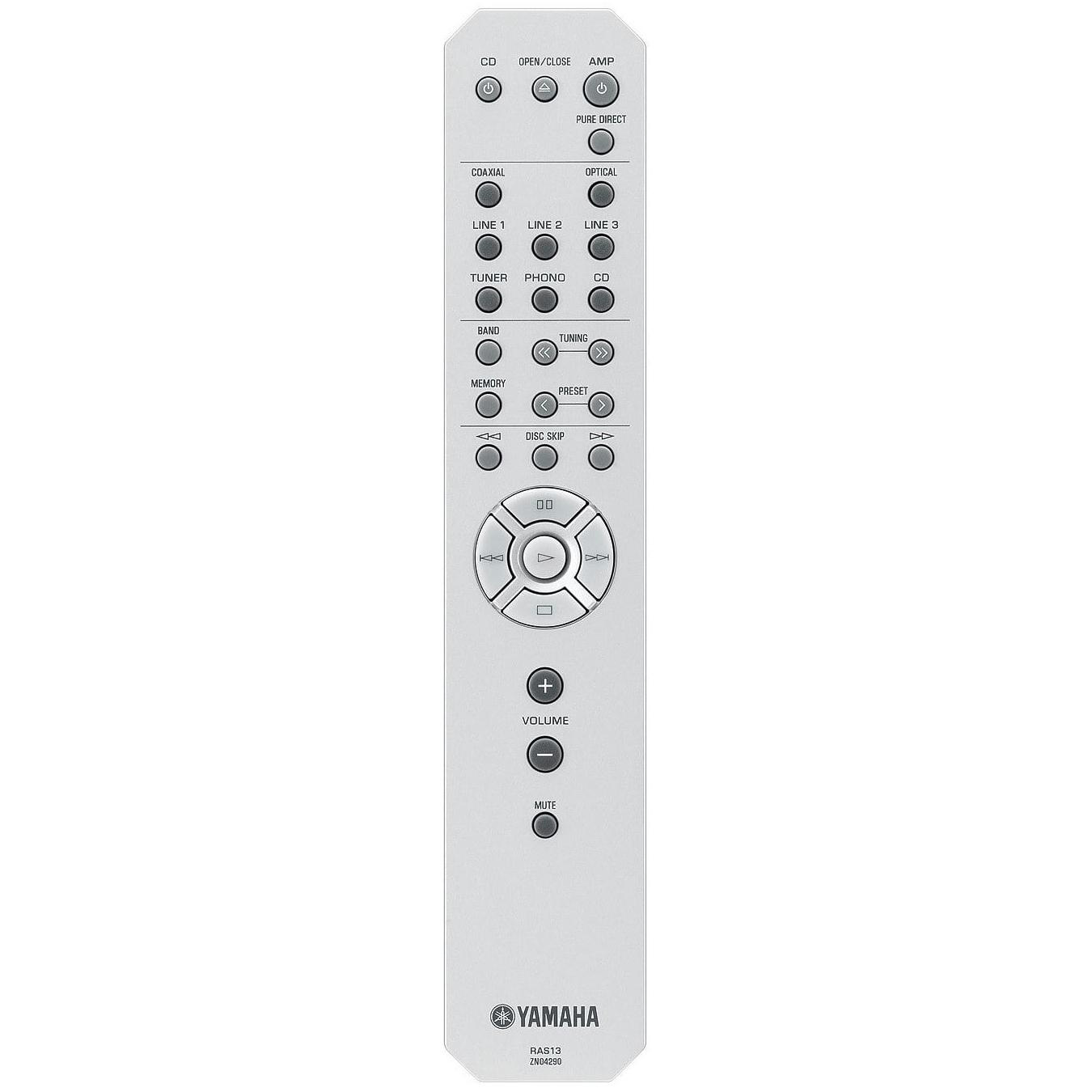
Yamaha A-S301 integrated amplifier
60 W/8 Ω, 70 W/6 Ω · min load 4 Ω · class AB · phono MM, DAC, sub-out, headphones · current: unknown; drive: unknown; dynamic (spec.); speakers ≥ 88.8 dB/W · room 12–30 m² · mid
Instalment: Buy now, pay later: 0-0-10 at our expense
prices and stock as of 2026-11-05
Audiomania expert verdict
A classic Yamaha class-AB integrated: 60 W into 8 Ω / 70 W into 6 Ω (dynamic 100/120), damping > 210, an MM phono stage, a 24/192 DAC on optical and coax, two speaker pairs, a sub output, loudness and Pure Direct. In Audiomania specialists' experience a “bright, dynamic” amplifier for electronic music and rock on neutral DALI/ELAC in rooms up to 30 m²; for energy-hungry three-way speakers take the A-S501. AI draft, under review
Ask about Yamaha A-S301
Will it suit your amplifier or room, what else to buy, what to compare with.
In brief
Best if you are looking for:
- a first proper system with vinyl: an MM phono stage, 4 line inputs, optical and coax on a 24/192 DAC — turntable, CD and computer at once AI draft, under review
- electronic, rock and metal on DALI / ELAC / JBL bookshelves — “a bright, dynamic amplifier”, “dense, dynamic sound” AI draft, under review
- rooms up to 30 m² on a sub-70k budget: “one of the few amplifiers that suits such a volume”, “only it has this much real power” AI draft, under review
- two speaker pairs (a second room) or bi-wiring, a subwoofer output, loudness for quiet evenings and Pure Direct AI draft, under review
Keep in mind:
- the character is bright and “dry”: with bright speakers (Klipsch, Spektor 2 treble) specialists suggest Marantz/Denon, and for this amp — neutral DALI or ELAC AI draft, under review
- energy-hungry three-way speakers (Yamaha NS-777, Radiotehnika S-90) it “cannot fully control” — look at the A-S501 and up AI draft, under review
- the card's 70 W is into 6 Ω; the manual says 60 W into 8 Ω. Two pairs at once — 8 Ω minimum, otherwise protection or failure AI draft, under review
- no Bluetooth or network (only a socket for an external module), no pre-out, no HDMI; AirPlay needs a network player AI draft, under review
Product DNA
L079%A structured sound passport: every value carries a source and a confidence.
- Current capability
- unknowncalculated0.5
- Drive class
- unknowncalculated0.5
- Sound character
- dynamicAudiomania specialist0.75
± 1
Alternative value
- analytical Audiomania specialist0.5
«получите более сухой звук» (против NAD 320 / Cambridge 340A); «более музыкальный Denon PMA-600NE» — яркость и сухость как аналитичность
- analytical Audiomania specialist0.5
- Speaker fit
- speakers from 88.8 dB/W, at least 6 Ω; rooms up to 40 m² at 88 dB/Wcalculated0.5
- Drives difficult loads
- noAudiomania specialist0.5
- Use scenarios
- no confirmed data
- Optimal room area
- 12–30 m² (10–40)Audiomania specialist0.5
- Tier
- midcalculated1
- What else you need
- speaker cablecalculated1
Sound profile
The profile appears after an Audiomania expert audition.
What the experts say
«Топ усилителей звука 2025 года ориентирован на тех, кто хочет получить стабильное, музыкальное и предсказуемое звучание в домашних условиях.»
Аудиомания · Мир Hi-Fi, 2025 Read the review
Sound character
Specialists agree on the wording: “a bright, dynamic amplifier”, “dense, dynamic sound that suits rock”, “excellent with electronic music”. Against a NAD 320 and a Cambridge 340A — “a drier sound”. AI draft, under review[4]
Buyers say the same in other words: “detailed, clean and powerful, not too bright… without unnecessary softness — Japanese”, “not soft, ringing”, “neutral”, “very picky about source quality”. In Direct it “thumps hard”, and loudness adds weight at low volume. AI draft, under review[4]
Use scenarios
Suits:
- vinyl + CD + a computer over optical in one system AI draft, under review
- electronic music and rock on DALI Spektor/Oberon, ELAC Debut, JBL Stage A180 AI draft, under review
- rooms up to 30 m² at a budget amplifier price AI draft, under review
- a second pair of speakers in another room (A/B) AI draft, under review
Less suited to:
- jazz and orchestral music — specialists point to Onkyo / Marantz / Denon AI draft, under review
- energy-hungry three-way floorstanders (NS-777, S-90) AI draft, under review
- home cinema, HDMI, streaming — no power-amp input, no HDMI, no network AI draft, under review
Technologies and construction
ToP-ART and the ART chassis
What it is: A fully symmetrical stage topology (ToP-ART) with minimal signal paths; a metal chassis built on the anti-resonance ART technology.
Practical benefit: Per the description — minimal distortion and crosstalk; specialists hear it as a “bright, dynamic” sound.
Custom transformer: 60/70 W, dynamic 100/120 W
What it is: A custom power transformer; 60 W into 8 Ω, 70 W into 6 Ω (both channels, 20 Hz–20 kHz), dynamic 100/120 W; damping factor over 210.
Practical benefit: “Only it has this much power in reality, not on paper” under 30k (specialist, 2020).
Loudness and Pure Direct
What it is: Bass/treble controls, switchable loudness for low volume, a Pure Direct mode bypassing all processing.
Practical benefit: Quiet evenings with loudness; “in Direct it thumps hard” (review).
MM phono stage
What it is: A built-in MM cartridge input, S/N 82 dB (phono), a ground terminal.
Practical benefit: “A pretty decent phono stage”; with an AT-LP120X — “good” sound (buyers); on par with the Onkyo A-9130 (specialist).
24/192 DAC: optical and coax
What it is: Optical and coax inputs, digital signal up to 24-bit/192 kHz; the chip is not disclosed by the manufacturer.
Practical benefit: TV and computer over optical (galvanic isolation); “FLAC over optical plays very detailed” (review).
Two A/B speaker terminal pairs
What it is: Two pairs of screw terminals: a second room or bi-wiring one pair.
Practical benefit: Simultaneously — 8 Ω speakers only; per a specialist bi-wiring is optional (“a good conventional connection will do”).
Subwoofer and record outputs
What it is: A low-level subwoofer output and a record output; no pre-out.
Practical benefit: Practically any active sub connects directly (unlike the A-S201); the cut-off is around 90 Hz per an owner.
Which speakers it drives
- Speaker fit
- speakers from 88.8 dB/W, at least 6 Ω; rooms up to 40 m² at 88 dB/Wcalculated0.5
- Current capability
- unknowncalculated0.5
- Drives difficult loads
- noAudiomania specialist0.5
- Minimum load
- 4 Ω (one pair), 8 Ω (both pairs)Audiomania specialist0.75
- Proven speaker pairings
- neutral, slightly warm, warm — “The Yamaha A-S301 is a bright, dynamic amplifier”, so specialists pair it with neutral and warm speakers: DALI (Spektor 2/6, Oberon 1/5, Zensor 3 — “fairly neutral with an even tonal balance”), ELAC Debut B5.2/B6.2, Arslab Classic 1.5, JBL Stage A180; buyers — Monitor Audio, Heco, Magnat, Acoustic EnergyAudiomania specialist0.75
- Output power
- 60 W / 8 Ω, 70 W / 6 Ωmanufacturer1
± 1
Alternative value
- 70 W / 6 Ω spec sheet1
Выходная мощность | 2 х 70 Вт (6 Ом, коэффициент гармоник 0,038%) — строка таблицы, только 6 Ом
- 70 W / 6 Ω spec sheet1
Suitable speakers in stock
89,313 RUB · in stock
Why
Wharfedale Linton 85th Anniversary: 4 Ω nominal — Yamaha A-S301 is rated for loads from 4 Ω, compatible. Yamaha A-S301 delivers ≈70 W into 6 Ω; the practice band for Wharfedale Linton 85th Anniversary in 21 m² at an average level is 32–54 W. Adequate.
61,990 RUB · in stock
Why
Radiotehnika Sigma 1.01: 8 Ω nominal — Yamaha A-S301 is rated for loads from 4 Ω, compatible. Yamaha A-S301 delivers ≈60 W into 8 Ω; the practice band for Radiotehnika Sigma 1.01 in 21 m² at an average level is 38–64 W. Adequate.
- KEF Q750 floorstanding speakersadequate
99,000 RUB · in stock
Why
KEF Q750: 8 Ω nominal — Yamaha A-S301 is rated for loads from 4 Ω, compatible. Yamaha A-S301 delivers ≈60 W into 8 Ω; the practice band for KEF Q750 in 21 m² at an average level is 46–77 W. Adequate.
124,990 RUB · in stock
Why
Radiotehnika Sigma 1.02: 6 Ω nominal — Yamaha A-S301 is rated for loads from 4 Ω, compatible. Yamaha A-S301 delivers ≈70 W into 6 Ω; the practice band for Radiotehnika Sigma 1.02 in 21 m² at an average level is 41–69 W. Adequate.
Which sources connect
- Inputs
- Phono MM, RCA line ×4, optical, coaxial
- Outputs
- Sub Out, Rec Out, speaker outputs ×2, 6.3 mm headphone
49,880 RUB · in stock
Why
Audiolab D7 → Yamaha A-S301: via analogue RCA (or digitally: optical/coaxial).
39,525 RUB · in stock
Why
iFi audio ZEN Stream → Yamaha A-S301: via the coaxial digital input.
12,282 RUB · in stock
Why
Premiera SX1 Pro → Yamaha A-S301: via analogue RCA (or digitally: optical).
Recommended right now
over the 45-product sampleIn-stock, current models only; refreshed with prices (2026-11-05). Not indexed.
89,313 RUB · in stock
Why
Wharfedale Linton 85th Anniversary: 4 Ω nominal — Yamaha A-S301 is rated for loads from 4 Ω, compatible. Yamaha A-S301 delivers ≈70 W into 6 Ω; the practice band for Wharfedale Linton 85th Anniversary in 21 m² at an average level is 32–54 W. Adequate.
61,990 RUB · in stock
Why
Radiotehnika Sigma 1.01: 8 Ω nominal — Yamaha A-S301 is rated for loads from 4 Ω, compatible. Yamaha A-S301 delivers ≈60 W into 8 Ω; the practice band for Radiotehnika Sigma 1.01 in 21 m² at an average level is 38–64 W. Adequate.
- KEF Q750 floorstanding speakersadequate
99,000 RUB · in stock
Why
KEF Q750: 8 Ω nominal — Yamaha A-S301 is rated for loads from 4 Ω, compatible. Yamaha A-S301 delivers ≈60 W into 8 Ω; the practice band for KEF Q750 in 21 m² at an average level is 46–77 W. Adequate.
124,990 RUB · in stock
Why
Radiotehnika Sigma 1.02: 6 Ω nominal — Yamaha A-S301 is rated for loads from 4 Ω, compatible. Yamaha A-S301 delivers ≈70 W into 6 Ω; the practice band for Radiotehnika Sigma 1.02 in 21 m² at an average level is 41–69 W. Adequate.
rules version 1.0.0+c1.0.0
Audiomania ready systems
Assembled by the rules from in-stock products around this model; prices as of 2026-11-05.
Optimal
- Speakers: Radiotehnika Sigma 1.01 bookshelf speakers61,990 RUB
- Amplifier: Yamaha A-S301 integrated amplifier (this model)71,390 RUB
- Speaker cable: Radiotehnika Volna SP2.5 Banana finished speaker cable9,690 RUB
- Stands: Radiotehnika T6 speaker stands19,990 RUB
Total: 163,060 RUB
Checks (10)
- R-ROOM-FITideal
- R-PLACEMENTno data
- R-SUB-NEEDnot needed
- R-AMP-IMPEDANCEfits
- R-AMP-POWERadequate
- R-SOURCE-CHAINincompatible
- R-AMP-CHARACTERfine
- R-TIER-FITbalanced
- R-CABLEfits
- R-STANDgood
Optimal
- Speakers: Wharfedale Linton 85th Anniversary bookshelf speakers89,313 RUB
- Amplifier: Yamaha A-S301 integrated amplifier (this model)71,390 RUB
- Streamer: Premiera SX1 Pro network streamer12,282 RUB
- Speaker cable: Radiotehnika Volna SP2.5 Banana finished speaker cable9,690 RUB
- Stands: Radiotehnika T6 speaker stands19,990 RUB
Total: 202,665 RUB
Checks (10)
- R-ROOM-FITideal
- R-PLACEMENTno data
- R-SUB-NEEDnot needed
- R-AMP-IMPEDANCEfits
- R-AMP-POWERadequate
- R-SOURCE-CHAINincompatible
- R-AMP-CHARACTERcomplementary
- R-TIER-FITbalanced
- R-CABLEfits
- R-STANDgood
Optimal
- Speakers: Radiotehnika Gamma 3.02 floorstanding speakers132,990 RUB
- Amplifier: Yamaha A-S301 integrated amplifier (this model)71,390 RUB
- Streamer: Premiera SX1 Pro network streamer12,282 RUB
- Speaker cable: Radiotehnika Volna SP2.5 Banana finished speaker cable9,690 RUB
Total: 226,352 RUB
Checks (9)
- R-ROOM-FITideal
- R-PLACEMENTno data
- R-SUB-NEEDoptional
- R-AMP-IMPEDANCEfits
- R-AMP-POWERadequate
- R-SOURCE-CHAINincompatible
- R-AMP-CHARACTERcomplementary
- R-TIER-FITbalanced
- R-CABLEfits
Comparison with similar models
How it differs from Rotel A11 Tribute integrated amplifier
Yamaha A-S301 integrated amplifier:
- Power into 8 Ω: 60 W vs 50 W
Rotel A11 Tribute integrated amplifier:
—
Yamaha A-S301 and Rotel A11 Tribute are the same tier; they differ in character and in the figures below.
Full comparison →How it differs from Audiolab 6000A integrated amplifier
Yamaha A-S301 integrated amplifier:
- Power into 8 Ω: 60 W vs 50 W
Audiolab 6000A integrated amplifier:
—
The sound difference is not confirmed by sources — specs only.
Yamaha A-S301 and Audiolab 6000A are the same tier; they differ in character and in the figures below.
Full comparison →
Specifications
Main
- Output power
- 60 W / 8 Ω, 70 W / 6 Ωmanufacturer
± 1
sources disagree
- 70 W / 6 Ω spec sheet1
Выходная мощность | 2 х 70 Вт (6 Ом, коэффициент гармоник 0,038%) — строка таблицы, только 6 Ом
- 70 W / 6 Ω spec sheet1
- Dynamic power
- 100 W / 8 Ω, 120 W / 6 Ωmanufacturer
- Power rating conditions
- both channels; THD, %: 0.038; bandwidth: 20 Гц – 20 кГцmanufacturer
- Topology
- class ABmanufacturer
- Damping factor
- 210
- Minimum load
- 4 Ω (one pair), 8 Ω (both pairs)Audiomania specialist
- A/B switch
- yesmanufacturer
- Line input sensitivity
- 380 mV
- DAC
- PCM up to: 24/192; no: MQA
- Main in (HT bypass)
- no
- Tone controls
- present, bypass, loudnessmanufacturer
- Direct mode
- yesmanufacturer
Construction
- Finishes
- Black
Connection
- Speaker output pairs
- 2
- Inputs
- Phono MM, RCA line ×4, optical, coaxial
- Outputs
- Sub Out, Rec Out, speaker outputs ×2, 6.3 mm headphone
- Phono input
- MM; no: MC
- HDMI ARC
- none
- HDMI CEC
- nonecalculated
- USB audio input
- none
- Bluetooth
- codecs: ; no: receive, transmit
- Pre Out
- no
- Sub Out
- mono
- Rec Out
- yes
- Headphone output
- jack: 6.3 mm
- 12 V trigger
- no: in-ear, out of stock
- Remote
- IR remoteAudiomania specialist
Dimensions
- Dimensions (W×H×D)
- 435 × 151 × 387 mm
Weight
- Weight
- 9 kg
Box contents
- Warranty
- 12 months
- In the box
- Пульт ДУAudiomania specialist
Documents
FAQ
›The description says 2 × 70 W but Yamaha's site says 60 W — which is right?
›Can I connect 4 Ω speakers (S-90, Elektronika 35AC-015, Amfiton)?
›Can I run two speaker pairs at once (4 and 6 Ω)?
›Will it drive high-impedance headphones (DT 770 Pro 250 Ω, HD 650 300 Ω)?
›A-S301 or A-S501?
›Which bookshelf speakers for the A-S301?
›Is it enough for a 30 m² room with high ceilings?
›How do I connect a subwoofer?
›How do I connect a TV, Blu-ray and a computer?
›How do I find the production year?
›Can I connect a centre channel?
Customer reviews
4.8 of 5 · 31 ratingsАлександр М., Златоуст · 2022-03-19Excellentverified purchase
Даже древняя акустика Амфитон стала радовать своим звуком, но она в принципе морально устарела и не даёт всей полноты красок и нюансов, на что способен усилитель Yamaha A-S301
Николай И., Шадринск · 2022-03-10Excellentverified purchase
Стереоусилитель Yamaha A-S30 понравился. Кнечно не столь крут, но для меня всё в норме. Что ещё нужно мужчине на 7_ мом десятке. Заказывал 28 июля. Хотел уже возврат денежных средств сделать. Думаю, подожду ещё день другой и откажусь от заказа. И вот чудо, дождался. Многие сейчас делают возврат (судя по записям в вопрос-ответ). Не спешите с решением. Наберитесь терпения и не ругайте сотрудников Аудиомании. Их вины нет. Ребята и так стараются, как могут.
Валентин С., Орёл · 2022-03-09Goodverified purchase
Хороший аппарат за свои бюджетные деньги.
Анна К., Москва · 2022-03-09Excellentverified purchase
Прекрасный усилитель
Алексей О., Киров · 2022-03-07Excellentverified purchase
Профи своего дела!
Сергей Л., Малоярославец · 2021-07-10Excellentverified purchase
Отличный аппарат для своей цены и с коммутацией все в порядке, есть все что мне нужно, да и мощность с запасом, однозначно 5 из 5.
Сергей С., Кемерово · 2021-01-13Excellentverified purchase
Спасибо сайту Аудиомания и его дружному коллективу. Приобрёл первый усилитель, подключил аппаратуру и наслаждаюсь музыкой. Усилитель очень прост в обращении. Слушая винил думаешь: как же я рад что его приобрёл!
Кирилл Х., Санкт-Петербург · 2020-12-17Excellentverified purchase
Отличный усилитель под мои музыкальные предпочтения. Запас мощности и напор впечатляют.
+9
AI summary of customer reviews
Based on 17 customer reviews.Most often noted:
- detailed, clean, powerful sound with volume to spare AI draft, under review
- universal across genres and “friendly” with varied speakers (Monitor Audio, JBL, Heco, Acoustic Energy) AI draft, under review
- a decent built-in phono stage and optical DAC AI draft, under review
Sometimes mentioned:
- bright / “ringing” sound, picky about recording quality AI draft, under review
- bass liked less than treble; tone knobs don't click clearly at zero AI draft, under review
Audiomania expert opinion
In the discussions the A-S301 is the most frequent “first amplifier” and the most frequent answer to “will it suit…”: specialists confirm pairings with DALI Spektor/Oberon/Zensor, ELAC Debut B5.2/B6.2, JBL Stage A180, Arslab Classic 1.5 and even the Soviet 4 Ω Elektronika 35AC-015. In 2020 it was called “the optimal choice” under 30k: “only it has this much power in reality, not on paper”. AI draft, under review[4]
The character is bright and dry, not soft — a plus for electronic music and rock, a minus for those expecting Denon/Marantz “musicality”. The control limits are stated honestly: NS-777 and S-90 are already A-S501 territory, and two pairs at once need 8 Ω. AI draft, under review[4]